
Quick Summary:
Real estate development is no longer just about blueprints and permits; it is about permission. As the INGAGE Blog outlines, the biggest risk to modern development projects isn’t a lack of capital—it is a lack of community trust. By treating Public Affairs as a “Day One” priority rather than a “Crisis Management” tool, developers can turn potential opponents into partners, ensuring that when the shovels hit the ground, the community is cheering, not suing.
The Inherent Friction: “The Blueprint” Vs. “The Backyard”
Developers and communities often view the same project through two entirely different lenses.
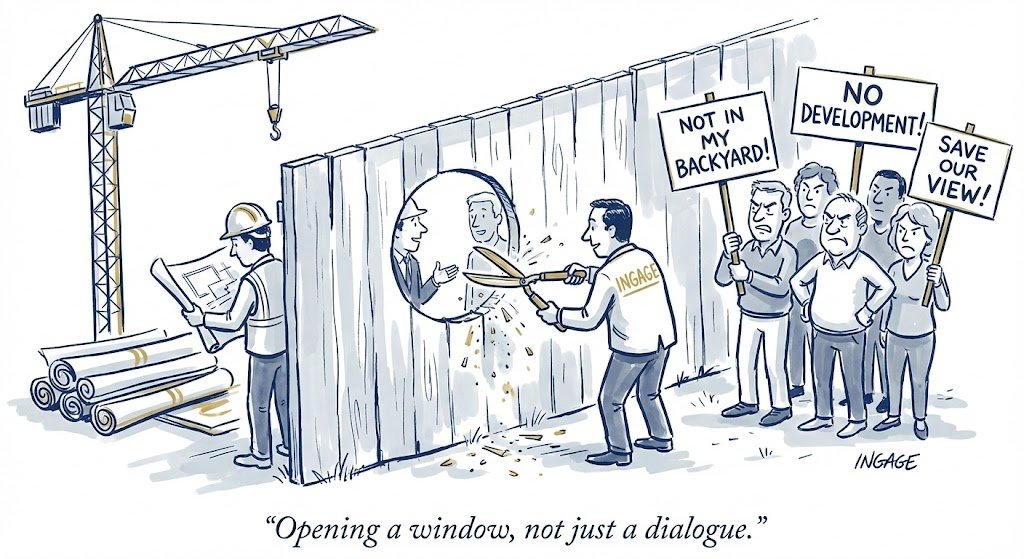
On one side is The Developer, armed with data, renderings, and economic impact studies. They see progress, jobs, and revitalization. On the other side is The Neighbor, armed with fear of the unknown. They see traffic, noise, and gentrification. The friction lies in the fact that while the developer is solving for density, the neighbor is solving for livability. When these two visions collide without a mediator, projects die in zoning hearings.
Why This Disconnect Is Dangerous
INGAGE warns that waiting until the public hearing to engage the community is a fatal error. Reliance on traditional public meetings often amplifies the loudest dissenting voices while ignoring the silent majority. Research indicates that when developers engage communities digitally before breaking ground, projects are significantly less likely to face costly litigation or zoning delays.
The “NIMBY” Mobilization: “Not In My Backyard” groups organize fast on social media. If you haven’t defined your narrative before they define it for you, you will spend months fighting misinformation instead of building.
Political Paralysis: Local commissioners listen to voters, not just developers. If a commissioner’s inbox is flooded with angry emails, they will likely delay or vote down your project to save their own political capital.
Costly Delays: Every month of delay due to community opposition burns cash. Legal fees, holding costs, and redesigns can turn a profitable project into a loss leader.
The INGAGE Methodology: The “No Surprises” Rule
The INGAGE approach is rooted in “Early & Often” engagement.
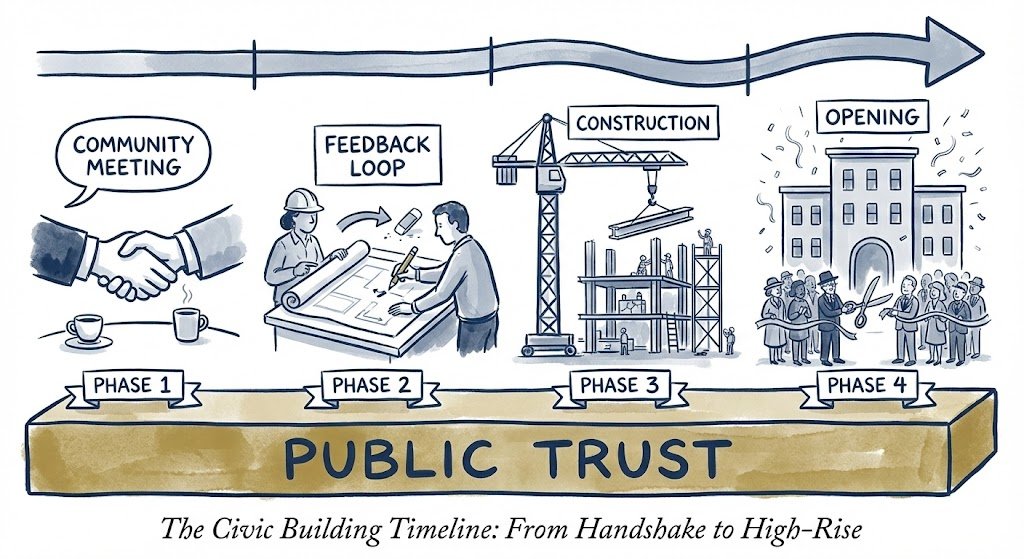
This methodology treats the community as a stakeholder, not an obstacle. By launching a Public Affairs strategy before the first permit is filed, developers can identify the “Third Rail” issues (e.g., parking, shade trees) and address them proactively. This strategy turns the standard “Decide-Announce-Defend” model on its head, replacing it with “Engage-Adjust-Approve.”
Comparison: The Silent Builder vs. The Community Partner
Here is the difference between a project that gets stalled and one that gets built.
| Feature | The Silent Builder (Traditional) | The Community Partner (INGAGE Model) |
| First Engagement | At the mandatory public hearing | Months before filing permits |
| Communication Style | Legal Notices & PDFs | Town Halls, Microsites & Social Media |
| View of Neighbors | Obstacles to be managed | Partners to be consulted |
| Outcome | Anger, Delays & Lawsuits | Trust, Adjustments & Approval |
| Legacy | “The project we fought” | “The project we helped shape” |
3 Steps To Build Political Capital
Based on the insights from the article, here is how developers can de-risk their projects through Public Affairs.
1. Map the “Influencer” Landscape
It isn’t just about the Mayor.
Action: Identify the unofficial leaders—the HOA president, the local pastor, the long-time business owner. Meet them for coffee before you meet them at the podium. Their endorsement is often worth more than a zoning lawyer’s argument.
2. Digital Transparency Hub
Don’t make residents dig for information.
Action: Launch a project-specific microsite or landing page on “Day One.” Post the FAQs, the construction timeline, and the benefits (jobs, tax revenue). If you provide the facts, the rumor mill has no fuel. Static PDFs on a website are not enough. Create an interactive project portal—using platforms like coUrbanize—where residents can view renderings, submit feedback, and see real-time timeline updates.
3. The “Give-Get” Strategy
Community benefits shouldn’t be an afterthought.
Action: Proactively offer benefits that solve existing neighborhood problems. If the area floods, fix the drainage. If the park is run-down, upgrade it. Frame the development as the funding source for the improvements the community has wanted for years. Identifying your supporters is only the first step; mobilizing them is where the battle is won. We utilize constituent advocacy campaigns to turn passive neighbors into vocal proponents who show up when it counts.
Frequently Asked Questions (FAQ)
What is the difference between PR and Public Affairs for development?
PR focuses on selling units to future buyers (marketing). Public Affairs focuses on selling the existence of the project to current neighbors and politicians (permission). You need both, but Public Affairs comes first.
Can’t I just rely on my land-use attorney?
Attorneys handle the legal compliance; Public Affairs handles the political compliance. An attorney can prove you are legally allowed to build, but they can’t stop 500 angry residents from showing up to protest. Public Affairs manages the emotion that the law ignores.
When should I start my Public Affairs strategy?
Ideally, during the due diligence phase. Understanding the political appetite for your project before you close on the land can save you millions. At the latest, start 3-6 months before your first public hearing.
Does community engagement mean I have to change my design?
Sometimes, yes—but usually in minor ways that save the project. Moving a delivery entrance or lowering a fence height might cost a little, but it buys you the goodwill needed to keep your density and height.
Is your project ready for the public spotlight?
Contact the INGAGE team today to build a Public Affairs strategy that secures your permits by securing the community’s trust.
Questions? Reach out to our team to learn more about how we can help you connect with your community and position your next project for success.