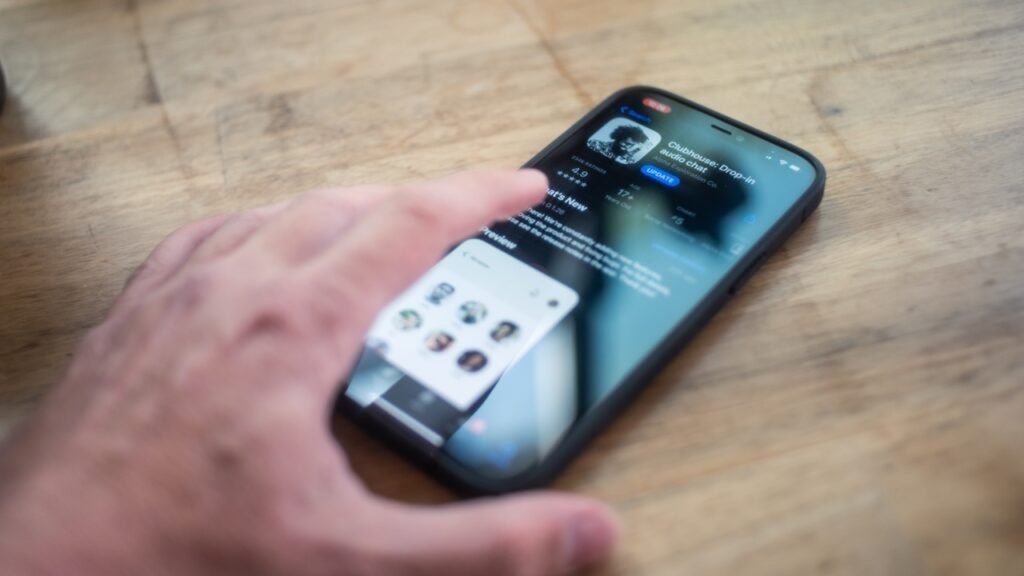
Quick Summary: When a new social platform like Clubhouse explodes onto the scene, businesses face a common dilemma: join early to capture the “first-mover advantage,” or wait to see if the hype survives? As explored in the INGAGE blog, the answer isn’t about chasing trends—it’s about evaluating bandwidth. Clubhouse offers a unique, audio-only intimacy that builds deep trust, but it demands a heavy investment of time. The smart move? Audit the room before you take the stage.
The Inherent Friction: “Fear of Missing Out” Vs. “ROI Reality”
Every time a new platform dominates the headlines—whether it’s Clubhouse, TikTok, or Threads—marketing teams and business leaders find themselves in a predictable conflict.
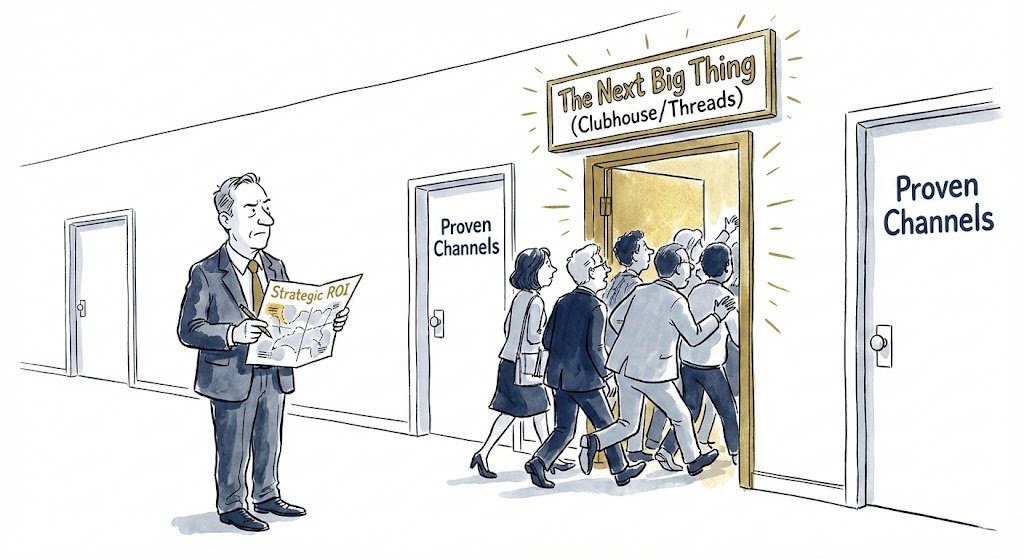
On one side, the “Early Adopters” (often PR and Social Teams) feel the pressure of FOMO. They worry that if they don’t claim their real estate now, they will lose relevance or miss the chance to build an organic following before the algorithm changes.
On the other side, “Resource Guardians” (Leadership and Operations) see a time-sink. They know that “being present” on a platform is easy, but being effective requires hours of unscripted engagement—time that could be spent on proven revenue channels.
Why This Disconnect Is Dangerous
The INGAGE perspective warns that reacting impulsively to platform hype leads to “Digital Dilution.”
- If you ignore it completely: You risk ceding the narrative to competitors. In the case of Clubhouse, early adopters who established themselves as thought leaders built massive, loyal networks that other channels (like LinkedIn) couldn’t replicate.
- If you dive in without strategy: You burn valuable executive time. Unlike Twitter or Instagram, where posts can be scheduled, live audio platforms require presence. An executive spending 10 hours a week in chat rooms with no clear ROI is a massive operational leak.
The “Lockstep” Methodology: Purpose-Driven Participation
The INGAGE approach to evaluating Clubhouse (or any new network) is simple: Don’t just show up; show up with a purpose.
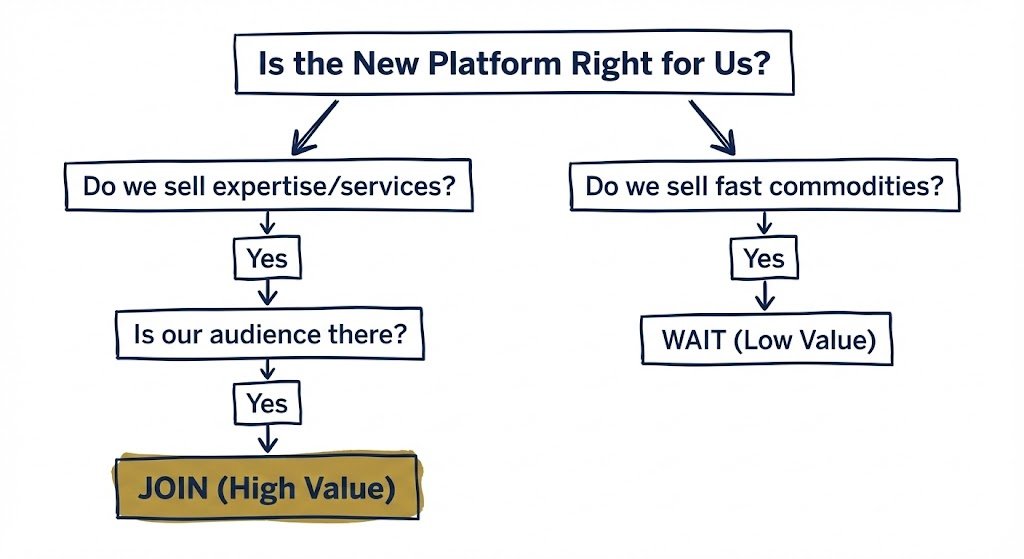
Clubhouse is not a broadcasting tool; it is a networking tool. It replicates the “hallway conversations” of a conference. Therefore, the metric for success isn’t “reach” (how many people saw it), but “resonance” (how deep the connection went). If your business relies on trust, expertise, and relationships (like law, consulting, or real estate), the platform works. If you sell high-volume commodities, it likely doesn’t.
Comparison: Feed-Based Social Vs. Audio-Social
To decide if Clubhouse is right for you, you must understand how it fundamentally differs from the tools you already use.
| Feature | Standard Social (LinkedIn/Instagram) | Audio Social (Clubhouse) |
| Primary Action | Scrolling & Posting | Listening & Speaking |
| Content Lifespan | Evergreen (Posts stay on profile) | Ephemeral (Live, then gone) |
| Engagement Style | Asynchronous (Reply whenever) | Synchronous (Real-time only) |
| Barrier to Entry | High Production (Needs visuals/copy) | High Time (Needs attention/voice) |
| Best For | Brand Awareness & Reach | Deep Trust & Authority |
3 Steps To Evaluate & Enter
If you decide to explore the platform, do not go in blind. Follow these steps to maximize impact while minimizing wasted time.
1. The “Silent Audit” (Listen First)
Before you host a room or speak on stage, spend one week purely as a listener.
- Action: Follow key influencers in your industry and observe the “room culture.” Note what topics spark engagement and, more importantly, what behavior causes people to leave the room (e.g., overly salesy pitches).
2. Optimize for “Searchable Authority”
On Clubhouse, your bio is your business card, your website, and your resume all in one.
- Action: Rewrite your bio to be SEO-friendly within the app. The first three lines are crucial because that is all people see when they tap your face in a room. State clearly who you help and why they should listen to you.
3. The “Co-Host” Strategy
Hosting a room alone is exhausting and risky (what if no one shows up?).
- Action: Partner with an existing voice in the space. “Lockstep” your entry by co-hosting a panel with a partner or client. This splits the burden of moderation and doubles the potential audience size immediate.
Frequently Asked Questions (FAQ)
Is Clubhouse still relevant for B2B businesses?
While the initial “hype” has settled, the mechanic of live audio remains powerful for B2B. Niche communities (like real estate investors or legal tech) still use these spaces for high-level networking that feels more authentic than a webinar.
How much time should I dedicate to Clubhouse?
Treat it like a networking event. You wouldn’t attend a conference for 24 hours straight. Dedicate 2-3 focused hours a week: one hour for listening/learning, and two hours for hosting or speaking in a targeted room.
Can I sell directly on Clubhouse?
Direct selling is often rejected by the community culture. Instead, use the “Soft Sell.” Provide immense value and answer questions on stage, then direct people to your Instagram or website (linked in your bio) to close the deal.
What if I don’t have an iPhone?
Clubhouse is now available on Android as well, removing the initial exclusivity barrier. This has opened the platform to a much wider global audience, making it more viable for international business reach.
Is your team distracted by the “Next Big Thing”?
Contact the INGAGE team today to help audit your communication channels and build a strategy that focuses on ROI, not just noise.
Schedule an initial complimentary call with a member of our team