Quick Summary:
Facts inform, but stories inspire. As the INGAGE Blog outlines, the most successful brands—whether they are law firms, non-profits, or corporations—don’t just list their services; they narrate their impact. Storytelling is the strategic tool that transforms a “transactional” service into a “relational” partnership. By shifting the focus from technical jargon to human resolution, organizations can bridge the gap between complexity and trust.
The Inherent Friction: “Technical Expertise” Vs. “Human Experience”
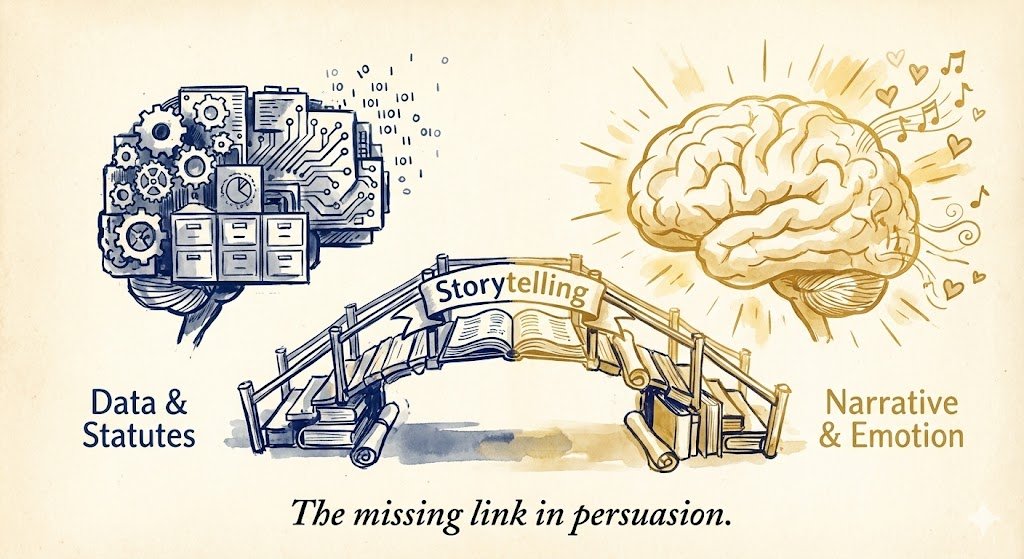
Professional service providers often struggle to communicate because they speak a different language than their clients.
On one side is The Expert. They focus on the “How”—the legal statutes, the technical specs, the logistical hurdles. On the other side is The Client. They focus on the “Who” and the “Why”—the person in trouble, the community in need, the fear of the unknown. The friction lies in the fact that while the expert is trying to prove competence with data, the client is looking for connection through empathy.
Why This Disconnect Is Dangerous
INGAGE warns that relying solely on dry facts creates a barrier to entry for potential clients.
The “Overwhelm” Effect: Law firms and non-profits often deal with complex, heavy topics. If you don’t simplify these into a narrative, you risk paralyzing your audience with information overload.
Lack of Differentiation: If every lawyer lists the same degrees and every non-profit lists the same statistics, they all look identical. Only a unique client story can distinguish you from the competition.
The Trust Gap: People buy from people, not corporations. If your marketing is sterile and corporate, it fails to build the “Parasocial Trust” required for a client to hand over their case or their donation.
The INGAGE Methodology: The “Resolution” Arc
The INGAGE approach to storytelling is not about fiction; it is about “Structured Authenticity.”
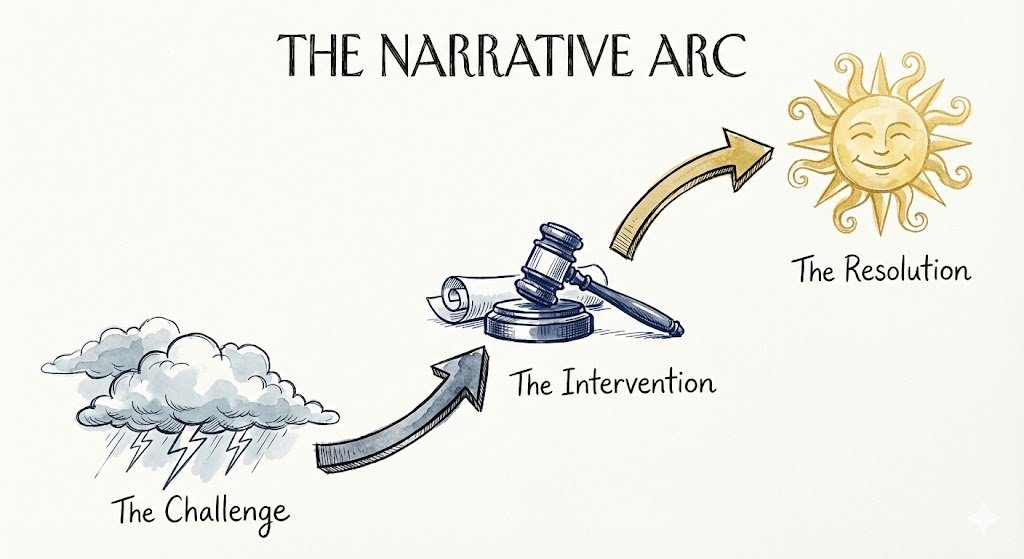
This methodology structures every marketing asset—from case studies to social posts—around a clear narrative arc: Problem, Solution, Resolution. It isn’t enough to say “We won the case.” You must introduce the stakes (The Problem), explain the strategic intervention (The Solution), and most importantly, highlight the human impact of the win (The Resolution). This turns a “legal service” into a “life-changing event.”
Comparison: The Resume vs. The Story
Here is the difference between marketing your credentials and marketing your impact.
| Feature | Resume Marketing (Traditional) | Storytelling Marketing (INGAGE) |
| Focus | “What we do” | “Who we help” |
| Primary Content | Awards & Degrees | Client Journeys & Impact |
| Goal | Impress with authority | Connect with empathy |
| Tone | Formal & Distant | Relatable & Human |
| Outcome | “They seem qualified.” | “They understand me.” |
3 Steps To Craft Your Narrative
Based on the insights from the article, here is how to turn your marketing into a story.
1. Define the Purpose
Every story needs a “Why.”
Action: Before drafting content, ask: Is this story meant to build trust (Past Client Success), raise awareness (Community Impact), or inspire action (Donor Urgency)? The goal dictates the structure.
2. Follow the Arc
Don’t just dump facts; build a journey.
Action: Use the classic three-act structure in your case studies.
Act 1: The Client’s Challenge (The Stakes).
Act 2: The Firm’s Strategy (The Action).
Act 3: The Outcome (The Relief).
3. Humanize the Data
Statistics are forgettable; people are memorable.
Action: Instead of saying “We helped 500 families,” tell the specific story of one family. Use that single narrative to illustrate the broader statistic. This is the “Identifiable Victim Effect”—people care more about one specific person than a generic group.
Frequently Asked Questions (FAQ)
Can a law firm tell stories without breaking confidentiality?
Yes. You tell “anonymized” stories. Change the names, industries, and specific details, but keep the emotional truth of the conflict and the resolution. The goal is to show your problem-solving process, not to reveal client secrets.
How do non-profits use storytelling differently?
For non-profits, the donor is the hero, not the organization. The story should show a problem, and then position the donor’s contribution as the catalyst that allows the organization to solve it.
Where should these stories live?
Everywhere. A long-form client story belongs on your Website (Case Studies). A bite-sized version belongs on Social Media (Instagram/LinkedIn). A personal reflection on the case belongs in your Email Newsletter.
Does storytelling help with SEO?
Indirectly, yes. Stories keep users on your page longer (“Dwell Time”), which signals to Google that your content is valuable. High-quality narratives are also more likely to be shared and linked to than dry service pages.
Is your brand memorable or just available?
Contact the INGAGE team today to learn how to craft stories that turn passive readers into active clients.
As the VP of Operations, Claudia is the go-to mind for all things at INGAGE. Learn more about Claudia..