

Quick Summary:
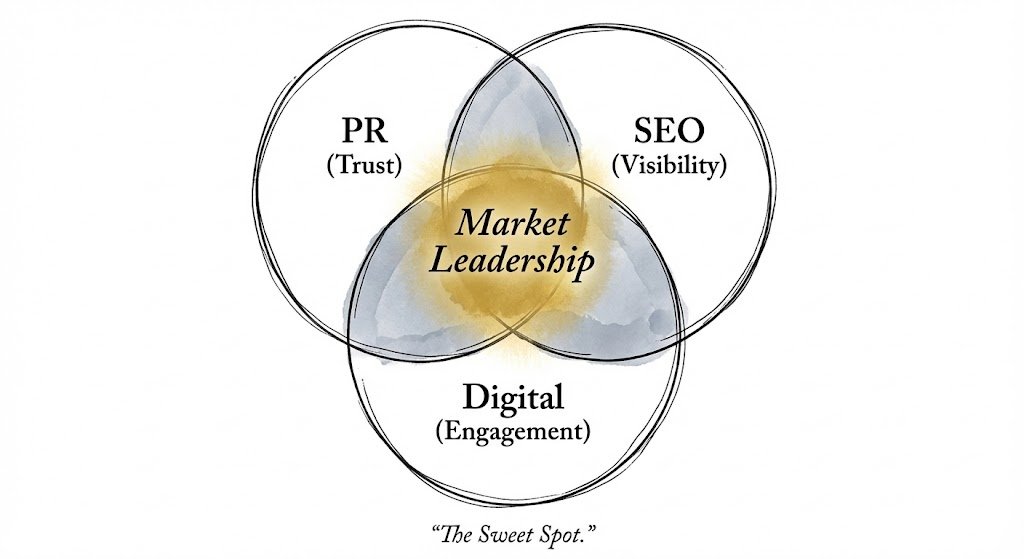
We have all seen that one competitor who appears to be everywhere: they are in your LinkedIn feed, in the news headlines, and at the top of your Google search results. This isn’t luck—it is Integrated Marketing. As the INGAGE Blog explains, the modern landscape requires breaking down the walls between Public Relations, Digital Strategy, and SEO. When these three disciplines operate as a single engine, they create a force multiplier effect that siloed teams simply cannot match.
The Inherent Friction: “Siloed Specialists” Vs. “Unified Impact”
In many organizations, marketing departments operate like separate islands.
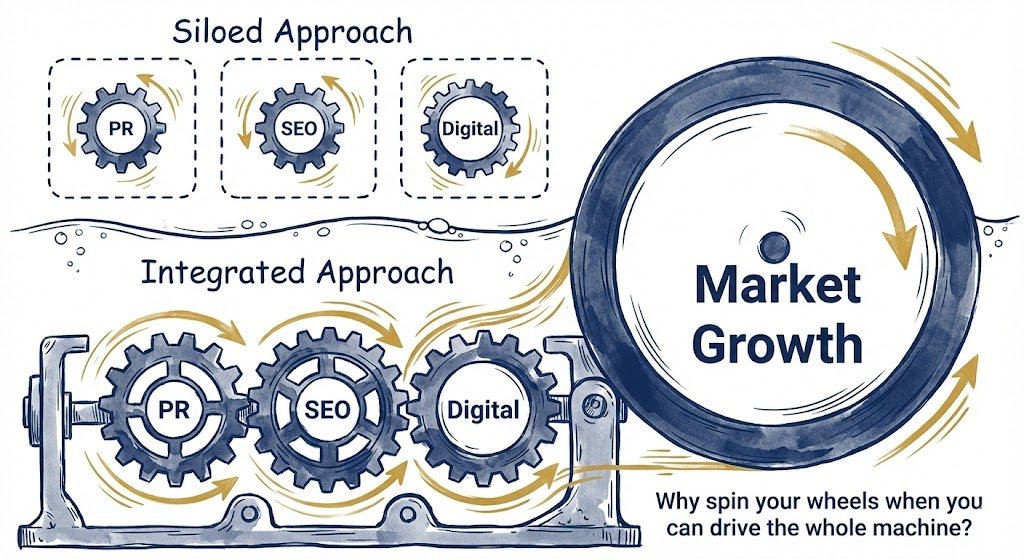
On one side is the PR Team, chasing editorial features and interviews. On the other is the SEO Team, obsessing over keywords and backlinks. Somewhere else is the Social Team, posting content that may not align with either. The friction lies in the waste. PR lands a huge story, but SEO doesn’t get the backlink. SEO optimizes a page, but Social never promotes it. Each team wins their specific battle, but the brand loses the war for dominance. The biggest barrier to growth isn’t a lack of talent; it’s a lack of communication. According to the Harvard Business Review, 86% of respondents cite a lack of collaboration or ineffective communication for workplace failures. When PR doesn’t talk to SEO, you don’t just lose efficiency—you lose revenue.
Why This Disconnect Is Dangerous
INGAGE warns that fragmentation is the enemy of ROI in a multi-channel world.
The “One-Hit Wonder” Problem: A PR hit in Forbes is great, but if it isn’t amplified by Digital and captured by SEO, its value dies in 24 hours. Integration extends the lifespan of every win.
Confusing the Customer: 73% of consumers shop across multiple channels. If your PR message says one thing and your Google Ad says another, you break the trust required to close the deal.
Inefficiency: When teams don’t share assets, you pay double. The photographer hired for the PR event should be shooting for the Social Team and the Website simultaneously.
The INGAGE Methodology: The Force Multiplier
The INGAGE approach views these disciplines not as separate departments, but as “Layers of the Same Story.”
This methodology relies on the “LinkedIn Nexus.” As the article highlights, platforms like LinkedIn have become media hubs where PR (news), Digital (sharing), and SEO (discoverability) converge. By aligning the teams, a single piece of content—like a white paper—becomes a press release, a series of social posts, and an SEO-optimized landing page, tripling the ROI of the initial effort.
Comparison: The Disconnected vs. The Connected Strategy
Here is the difference between a fragmented approach and the INGAGE integrated model.
| Feature | Fragmented Marketing (Silos) | Integrated Marketing (INGAGE) |
| Primary Goal | Departmental KPIs | Unified Business Growth |
| PR Role | Get the clip | Get the authority (SEO + Trust) |
| SEO Role | Rank for keywords | Capture PR-driven traffic |
| Social Role | Post daily | Amplify PR & SEO wins |
| Outcome | “Noise” | “Omnipresence” |
3 Steps To Unify Your Strategy
Based on the insights from the article, here is how to bridge the gaps between your teams.
1. The SEO-First Press Release
Don’t write for journalists alone; write for algorithms too.
Action: Before the PR team drafts a release, the SEO team should provide a list of “high-intent keywords.” Integrating these into the headline and body ensures that the news story helps you rank for the terms your clients are actually searching for.
2. The Social Amplification Loop
A media win is content, not just news.
Action: When a story runs, the Digital team should immediately break it down into an infographic, a pull-quote graphic, and a LinkedIn newsletter. Tag the journalist and the outlet to increase the chances of the platform’s editors picking it up for broader distribution.
3. Shared Analytics
Stop looking at three different dashboards.
Action: Create a “Master Report” that correlates activities. Did the Wall Street Journal feature (PR) cause a spike in “Direct Traffic” (SEO)? Did the viral LinkedIn post (Digital) lead to newsletter signups? Connect the dots to see what is actually driving revenue. Vanity metrics like ‘likes’ or ‘impressions’ tell only half the story. To truly understand ROI, successful campaigns must track 3 to 4 types of metrics —ranging from consumption and sharing to lead generation and sales impact.”
Frequently Asked Questions (FAQ)
Is integrated marketing more expensive?
Initially, it may seem so because you are investing in multiple channels. However, it is more efficient. By repurposing one asset across three channels, you lower your “Cost Per Lead” over time compared to paying three separate agencies to create three separate campaigns.
How does LinkedIn fit into integration?
LinkedIn is unique because it is both a social network and a publishing platform. It allows you to distribute PR content directly to decision-makers while boosting your SEO through its high domain authority.
Can one person handle all of this?
Rarely. While a generalist can manage the basics, true integration requires specialists (a PR pitch expert, a Technical SEO pro, a Creative Director) working under a unified strategy. This is why many firms choose an agency model over a single in-house hire.
How do we measure “Integration”?
You measure it by “Attribution.” Instead of just asking “How many likes did we get?”, you track the customer journey: They saw the news article -> Googled the brand -> Clicked the LinkedIn post -> Filled out the form.
Is your marketing working together or falling apart?
Contact the INGAGE team today to build a unified strategy that turns your separate efforts into a single, unstoppable force.
Contact us today to discover how our integrated approach can transform your marketing efforts.