
Quick Summary:
A website without SEO is like a billboard in a basement—it may be beautiful, but no one will ever see it. As the INGAGE Blog explains, over 90% of online experiences begin with a search engine, and the first five results capture nearly 70% of the clicks. If you aren’t ranking, you aren’t competing. SEO is the digital infrastructure that transforms your website from a passive brochure into an active lead-generation engine.
The Inherent Friction: “Creative Design” Vs. “Algorithmic Rules”
Website owners often struggle to balance aesthetics with discoverability.
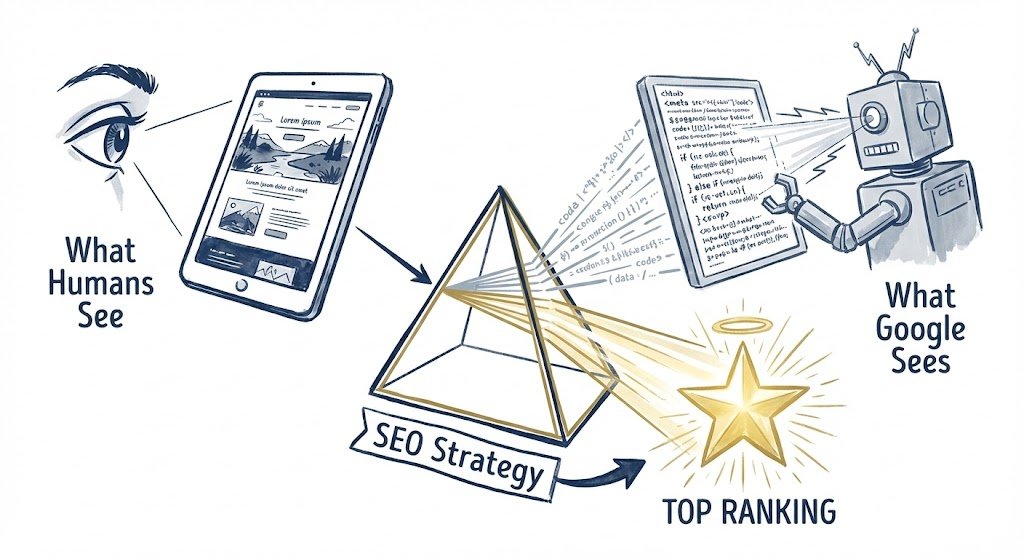
On one side is The Designer. They want sleek minimalism, large images, and clever headlines. On the other side is The Search Engine. Google wants structure, text density, and clear, descriptive headers. The friction lies in the fact that what looks good to a human eye (e.g., an image-heavy homepage) often looks “empty” to a search engine spider, causing the site to be invisible in search results.
Why This Disconnect Is Dangerous
INGAGE warns that ignoring the technical “language” of search engines leaves you invisible to potential clients.
The Invisible Expert: You might be the best attorney or realtor in the city, but if your site lacks the right keywords and meta tags, clients searching for “best attorney near me” will find your inferior competitor instead.
The Mobile Penalty: Google uses “mobile-first indexing.” If your site looks great on a desktop but loads slowly on a phone, Google actively suppresses your ranking, cutting you off from the 60%+ of users who search via mobile.
The “Bounce” Effect: If you attract users but your content is hard to read (walls of text) or slow to load, they leave immediately (“bounce”). High bounce rates signal to Google that your site is low quality, pushing you further down the rankings.
The INGAGE Methodology: The Three Pillars of SEO
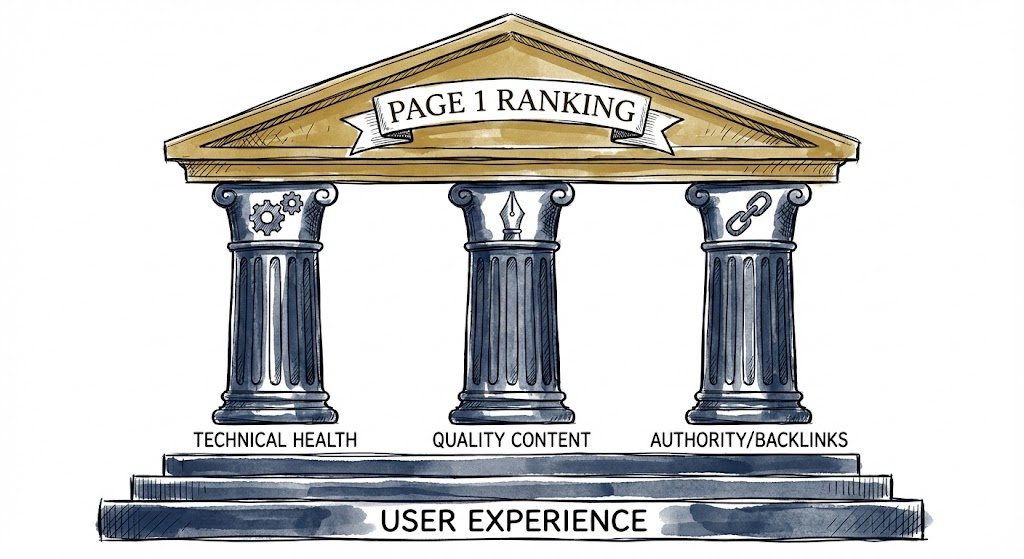
The INGAGE approach simplifies SEO into three core pillars: Technical Health, Content Quality, and Authority.
This methodology moves beyond “keyword stuffing” (an outdated tactic). Instead, it focuses on “User Intent.” Does your site load fast? (Technical). Does it answer the user’s question? (Content). Do other reputable sites link to it? (Authority). By balancing these three, you create a “flywheel” effect where higher rankings lead to more traffic, which leads to more backlinks, which leads to even higher rankings.
Comparison: Old School vs. Modern SEO
Here is how the game has changed.
| Feature | Old School SEO (2010s) | Modern SEO (INGAGE Model) |
| Primary Tactic | Keyword Stuffing | High-Quality Content |
| Focus | Tricking the Robot | Helping the User |
| Mobile Strategy | “Nice to have” | “Mobile First” (Mandatory) |
| Link Building | Buying spammy links | Earning reputable links |
| Outcome | Short-term spikes | Long-term dominance |
3 Steps To Improve Visibility
Based on the fundamentals shared in the article, here is how to start climbing the rankings.
1. Speak the Language (Keyword Research)
Don’t guess what clients want; know it.
Action: Use tools like Google Keyword Planner to find the exact phrases your clients use. Instead of just “Lawyer,” use “Personal Injury Attorney Miami.” Place these natural phrases in your H1 Headers, Title Tags, and the first paragraph of your content.
2. Speed is a Feature (Technical SEO)
A slow site is a broken site.
Action: Use Google PageSpeed Insights to test your site. If it takes longer than 3 seconds to load, you are losing traffic. Compress your images and fix broken links to ensure the Google “crawlers” can read your site without hitting speed bumps.
3. Build Your Reputation (Backlinks)
Google trusts sites that others trust.
Action: You cannot just write great content; you must share it. Guest post on reputable industry blogs or get featured in local news. When a trusted site (like a news outlet) links back to your site, it transfers “Domain Authority” to you, boosting your rank.
Frequently Asked Questions (FAQ)
How long does SEO take to work?
SEO is a marathon, not a sprint. While technical fixes can show results in weeks, building the authority required to rank for competitive terms usually takes 3-6 months of consistent effort.
Can I do SEO myself?
You can handle the basics (like writing good content and fixing broken links). However, technical SEO (site speed, schema markup) and competitive backlink strategies often require an agency’s tools and expertise.
What are “Meta Tags” and why do they matter?
Meta tags are snippets of text that describe a page’s content to search engines. They don’t appear on the page itself but show up in the search results. A compelling Meta Description acts like an ad copy—it convinces the user to click your link over the competitor’s.
Is SEO better than paid ads?
They work best together. Paid ads get you traffic today (but stop when you stop paying). SEO gets you traffic forever (once you rank). A balanced strategy uses ads for immediate leads while building SEO for long-term sustainability.
Is your website a billboard or a brochure?
Contact the INGAGE team today to audit your site and build an SEO strategy that puts you in front of the clients who are looking for you.
About the Author
Vanessa Gonzalez has 8+ years of experience, including previously serving as a Senior Account Executive at a Marketing and Branding focused agency based in Miami, FL. Vanessa graduated from Miami International University of Art and Design with a B.A. in Marketing and Merchandising and holds a M.S. in Digital Marketing from Florida International University. She currently serves as the Creative Director at INGAGE. Learn more about Vanessa.