

Quick Summary: In a saturated legal market, fighting for broad terms like “lawyer” is often a losing battle for smaller firms. The real growth lies in specificity. As INGAGE CEO Katherine Doble explains, long-tail keywords—specific phrases with three or more words—allow law firms to connect with clients at the exact moment of their highest intent. A “Lockstep” keyword strategy shifts the focus from high-volume competition to high-conversion precision, ensuring your firm is the clear answer to a client’s specific legal crisis.
The Inherent Friction: “Broad Awareness” vs. “Client Intent”
Attorneys often face a disconnect between the traffic they want and the clients they actually need.
On one side, Broad Keywords (e.g., “attorney” or “legal advice”) have massive search volumes but are hyper-competitive and attract “window shoppers” who may not be ready to hire. On the other side, Long-Tail Keywords (e.g., “personal injury lawyer for motorcycle accidents in Tampa”) have lower search volumes but capture users with a clear intent and a specific problem. The friction arises when a firm pours its budget into broad terms, only to find their inbox filled with irrelevant leads, while missing out on the highly qualified clients searching for niche expertise.
Why This Disconnect Is Dangerous
Relying solely on broad keywords can lead to a “hollow” digital presence where traffic is high but ROI is low.
Prohibitive Costs: Broad terms are the most expensive to bid on in Google Ads. Smaller firms can quickly drain their budgets competing with national giants for generic traffic.
Lower Conversion Rates: A user searching for “lawyer” is just starting their journey. A user searching for “Chapter 7 bankruptcy attorney in Miami” is ready to pick up the phone. If you don’t rank for the latter, you lose the conversion.
Invisible Niche Expertise: If your SEO strategy doesn’t highlight your specific practice areas through long-tail phrases, potential clients will never know you are the specialist they need.
The INGAGE “High-Intent Precision” Methodology
Katherine Doble advocates for a strategy rooted in Relevance and Conversion. At INGAGE, we believe that long-tail keywords are the bridge between a search query and a signed retainer.
By utilizing “Rapid Learning” of your specific practice area and “Strong Writing” that addresses nuanced legal questions, we help your firm dominate the specific niches where your ideal clients live. This methodology translates your unique legal strengths into a search strategy that bypasses the crowd and speaks directly to the decision-maker.
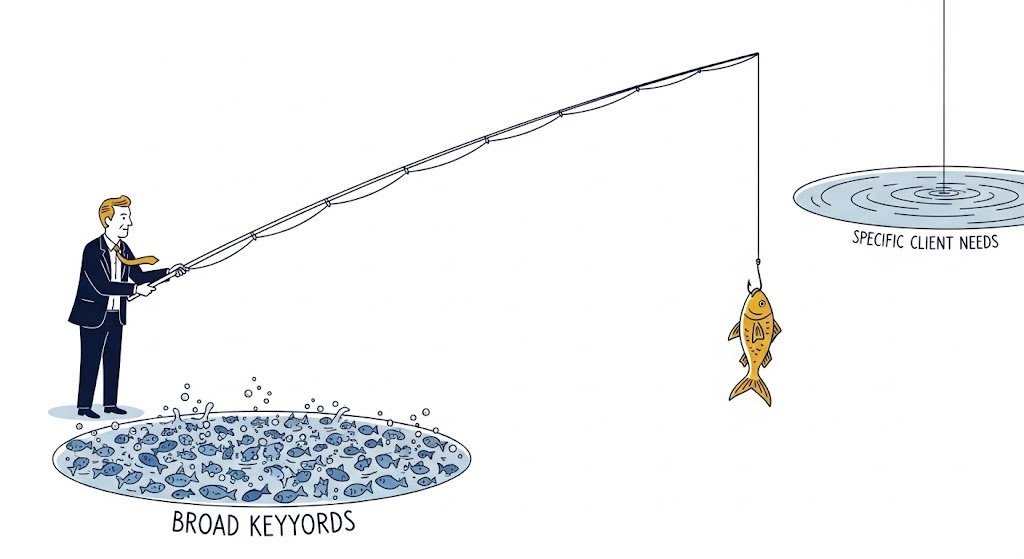
Comparison: Broad Keywords vs. Long-Tail Precision
| Feature | Broad Keywords (e.g., “Lawyer”) | Long-Tail Keywords (e.g., “PI Lawyer Tampa”) |
| Search Volume | Extremely High | Moderate to Low |
| Competition | Hyper-Competitive | Lower / Niche-Focused |
| User Intent | General Research | High Intent / Decision-Making |
| Cost (PPC) | Expensive | Cost-Effective |
| Conversion Rate | Low | High |
3 Tactics to Implement Long-Tail Keywords
To boost your conversion rates, you must move from generic visibility to specific authority.
1. Optimize for Practice & Place
Localize your expertise.
Action: Combine your specific service with your geographic location (e.g., “Commercial real estate litigation in Coral Gables”). This ensures you attract clients who are actually in your jurisdiction and looking for your specific skill set.
2. Answer the “Burning Question”
Use your blog to solve problems.
Action: Identify the common questions your clients ask during consultations. Turn these into long-tail headlines (e.g., “How long does a personal injury settlement take in Florida?”). This captures users searching for answers to their immediate legal anxieties.
3. Identify Keyword “Gaps”
Outmaneuver the competition.
Action: Use tools like Google Keyword Planner to find long-tail phrases your competitors are ignoring. By targeting these “gaps,” you can rank higher more quickly and establish yourself as the go-to authority in a less crowded space.

Frequently Asked Questions (FAQ)
Won’t I get less traffic if I only use long-tail keywords?
You will likely see a lower volume of traffic, but the quality of that traffic will be significantly higher. Long-tail keywords attract users who are further along in the decision-making process, meaning they are much more likely to convert into paying clients than general searchers.
How do I find the specific long-tail keywords for my firm?
Start by listening to your clients. What specific phrases do they use to describe their problems? You can also use “People Also Ask” sections on Google or tools like SEMrush to find specific questions and phrases that have a high intent but lower competition.
Is long-tail keyword strategy only for SEO?
No. Long-tail keywords are incredibly effective for PPC (Google Ads) as well. Because they are more specific, they often have a lower Cost-Per-Click (CPC) and a higher Click-Through-Rate (CTR), making your ad spend much more efficient.
Should I stop using broad keywords entirely?
Not necessarily. Broad keywords are good for general brand awareness. However, a balanced “Lockstep” strategy focuses the majority of conversion-driven efforts on long-tail keywords while using broad terms sparingly to maintain a general presence.
Is your SEO strategy targeting the right intent?
Contact the INGAGE team today for a keyword audit. We’ll help you identify the long-tail opportunities that will turn your website traffic into a consistent stream of high-value clients.