

Quick Summary: As featured in Legaltech News, the pandemic didn’t just interrupt the legal industry; it accelerated its digital evolution by a decade. INGAGE CEO Katherine Doble argues that the “temporary” digital fixes of 2020 have hardened into the “permanent” infrastructure of 2026. For law firms, a robust digital strategy is no longer a marketing option—it is an operational imperative for survival and growth.
The Inherent Friction: “Tradition” Vs. “Expectation”
The legal industry has historically thrived on tradition, face-to-face counsel, and physical presence. However, a massive friction has emerged between Firm Culture and Client Expectation.
The Traditional Firm views digital tools (Zoom, portals, social media) as emergency substitutes—impersonal necessities to be discarded when possible.
The Modern Client views these same tools as baseline standards for efficiency and accessibility. They have been trained by Amazon and online banking to expect instant, digital service.
This disconnect creates a dangerous “Experience Gap.” Firms waiting to “go back to normal” are failing to realize that their clients have already moved forward.

Why This Disconnect Is Dangerous
Katherine Doble warns that treating digital strategy as a “pandemic phase” rather than a permanent shift leads to obsolescence.
Loss of Top Talent: Modern legal talent demands flexibility. Firms that rigidly revert to pre-pandemic models struggle to recruit and retain the best lawyers who have adapted to hybrid efficiency.
Client Attrition: Clients will quietly migrate to firms that offer frictionless digital experiences (e.g., secure portals, automated updates) over those that require phone tag and paper mail.
Invisibility: In a digital-first world, a firm without a strong, content-driven digital presence effectively does not exist during the “Research Phase” of a client’s journey.
Katherine Doble’s Methodology: The “Digital-First” Firm
The INGAGE approach, as highlighted in Legaltech News, is not about replacing lawyers with robots. It is about “Augmented Advocacy.”
A permanent digital strategy uses technology to handle the process (scheduling, updates, payments, basic education) so that the lawyer can focus entirely on the counsel. This shift transforms the website from a “brochure” into a “24/7 Junior Associate” that vets leads and answers routine questions before a partner ever bills an hour.
Comparison: The Shift in Legal Operations
The definition of a “responsive firm” has fundamentally changed.
| Feature | Pre-Pandemic “Traditional” Model | Post-Pandemic “Permanent” Model |
| Client Communication | Scheduled calls & in-person meetings | Secure portals, async messaging, & video |
| Marketing Goal | “Networking” & Reputation | “Thought Leadership” & Search Authority |
| Content Strategy | Occasional newsletters | Continuous, searchable Q&A content |
| Speed | “We’ll get back to you next week” | “Here is your access link immediately” |
| Value Proposition | The Firm’s History/Prestige | The Firm’s Accessibility/Efficiency |
3 Steps To Cement Your Digital Strategy
Based on insights from Legaltech News, here is how firms can lock in their digital gains.
1. The “Virtual Lobby” Audit
Treat your website homepage exactly like your physical lobby. Is it welcoming? Is it clear where to go?
Action: implement a simple “triage” tool or chatbot on your site that directs potential clients immediately to the right practice area or resource, rather than forcing them to hunt through bio pages.
2. Content as Business Development
Stop writing about “firm news” and start writing about “client problems.”
Action: Task associates with writing one “FAQ” article per month based on a real question a client asked them. This builds a library of high-intent content that attracts clients who are actively searching for solutions.
3. Hybridize the Relationship
Don’t choose between digital and physical; blend them.
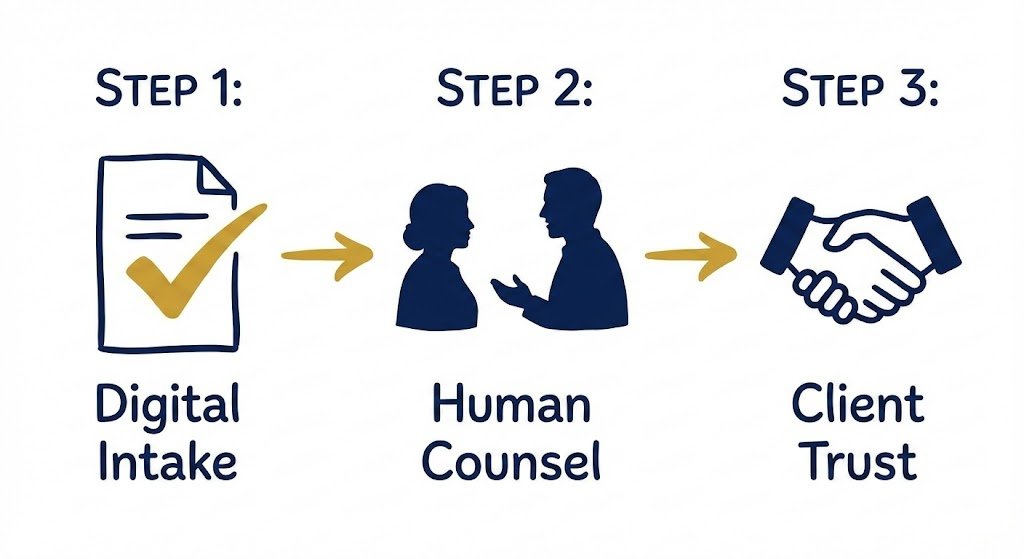
Action: Adopt a “Digital Onboarding, Human Counsel” policy. Use automated digital tools for intake forms and conflict checks, but ensure the first substantive interaction is a high-touch human conversation (video or in-person).
Frequently Asked Questions (FAQ)
Isn’t digital interaction less secure for law firms?
Not if done correctly. In fact, secure client portals are far safer than the “traditional” method of emailing unencrypted PDFs. A permanent digital strategy prioritizes cybersecurity as a core pillar of client trust, not an IT afterthought.
Will older clients accept a digital-first approach?
Surprisingly, yes. Data shows that demographics of all ages have adopted digital conveniences post-pandemic. The key is usability. If your digital tools are intuitive (like Amazon), older clients often prefer them to the friction of driving to an office for a simple signature.
How do we measure the ROI of a digital strategy?
Move beyond “website hits.” Measure “Time to Engagement” (how fast a lead becomes a consultation) and “Client Acquisition Cost.” A strong digital strategy should lower the cost of acquiring a client while increasing the speed of onboarding.
What is the biggest risk of ignoring this shift?
Irrelevance. As Legaltech News suggests, the “New Normal” is just “The Normal.” Firms that refuse to adapt will eventually find themselves unable to compete with agile firms that can service clients faster, cheaper, and more transparently.
Is your firm built for the past or the future?
Contact the INGAGE team today to transition your digital “band-aids” into a permanent, high-performance growth engine.