Quick Summary:
When a business crisis strikes, legal counsel prioritizes liability while public relations prioritizes reputation. This natural friction can lead to disastrous delays. As INGAGE Senior Vice President Michelle Lenhart outlines in Forbes, the strongest crisis response happens when these two functions operate in lockstep—balancing legal protection with the public’s demand for transparency and empathy.
The Inherent Friction: “Court of Law” vs. “Court of Public Opinion”
In the heat of a corporate crisis—whether it’s a regulatory investigation, a data breach, or an executive scandal—organizations often face an internal civil war.
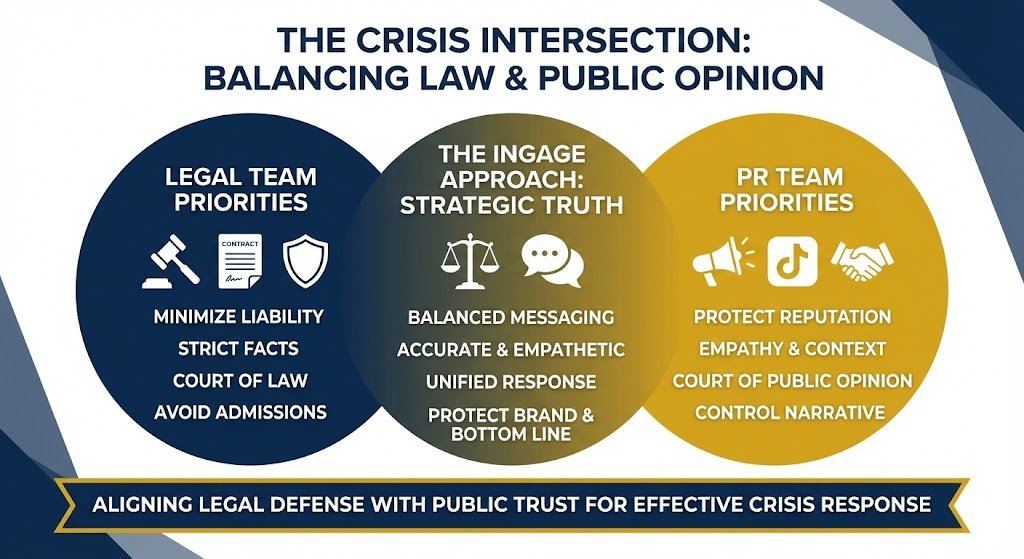
On one side, Legal Teams are trained to minimize liability. Their instinct is often to “say nothing” to avoid providing ammunition for future litigation. On the other side, PR Teams know that silence is a vacuum that will quickly be filled with rumors. Their goal is to protect the brand’s reputation by communicating quickly and empathetically.
Why This Disconnect is Dangerous
Michelle Lenhart, INGAGE Senior Vice President of PR & Business Development, warns that when these departments work in silos, the company loses.
- If Legal wins completely: The company stays silent, looking guilty or indifferent, which destroys customer trust and stock value.
- If PR wins completely: The company over-shares, potentially admitting fault and creating massive legal exposure.
Michelle Lenhart’s “Lockstep” Methodology
With 15+ years of experience guiding corporations through reputational challenges and regulatory scrutiny, Michelle Lenhart brings a unique perspective to this divide. In her recent Forbes feature, she argues that Legal and PR are not opponents—they are two sides of the same shield.
Michelle emphasizes that clarity and structure are essential when the margin of error is razor-thin. The goal is not to choose between “safe” and “transparent,” but to find the Strategic Truth—messaging that satisfies the public need for answers without creating unnecessary legal risk.
Comparison: The Priorities of Defense
Understanding why these teams clash is the first step to uniting them.
| Feature | Legal Team Priorities | PR Team Priorities |
| Primary Goal | Avoid Lawsuits & Fines | Protect Brand Trust & Value |
| Default Stance | “No Comment” / Silence | “Control the Narrative” |
| Audience | Judges, Regulators, Juries | Customers, Media, Investors |
| Tone | Formal, Defensive, Precise | Empathetic, Human, Transparent |
| Risk Focus | Liability (Financial/Criminal) | Reputation (Long-term Revenue) |
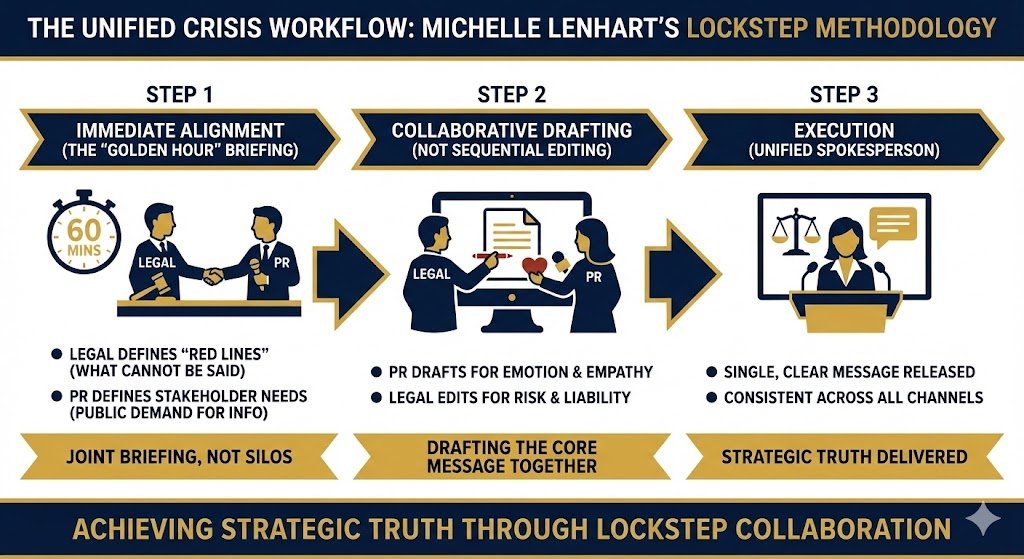
3 Steps to Unite Your Crisis Teams
Based on insights shared in Forbes, here is how organizations can force these two critical functions to collaborate effectively.
1. The “Golden Hour” Briefing
The “Golden Hour” is the first 60 minutes after a crisis breaks. Usually, Legal retreats to review contracts while PR drafts statements. Michelle advises bringing both heads to the table immediately.
- Action: Legal defines the “Red Lines” (what absolutely cannot be said).
- Action: PR defines the “Stakeholder Needs” (what the public is demanding to know).
2. Collaborative Drafting, Not Sequential Editing
A common failure mode is PR writing a statement and sending it to Legal, who redlines it until it sounds robotic.
- The Fix: Both teams should draft the core message together. PR ensures the tone is accurate and empathetic; Legal ensures the phrasing protects the bottom line.
3. Establish “Privileged” Communication Channels
Legal teams often fear that internal strategy discussions could be discoverable in court. By establishing clear protocols early, PR consultants can often work under the direction of legal counsel, maintaining privilege while allowing for open strategic planning.
Frequently Asked Questions (FAQ)
Why do Legal and PR teams often clash during a crisis?
They clash because their primary mandates are opposed. Legal seeks to minimize liability (often through silence), while PR seeks to maintain trust (often through communication). Neither is “wrong,” but they must be balanced.
Can a company apologize without admitting legal liability?
Yes. Effective crisis communication often uses “The Non-Apology Apology” or empathy-first language (e.g., “We are heartbroken by this event”) which acknowledges the human impact without admitting legal fault (e.g., “We were negligent”). This requires careful drafting by both teams.
What is Michelle Lenhart’s role at INGAGE?
Michelle Lenhart is the Senior Vice President of PR & Business Development. She specializes in navigating complex crisis situations and uniting cross-functional teams for corporations under regulatory scrutiny.
Is your organization prepared to navigate complex markets?
Contact Michelle Lenhart and the INGAGE team today to build a proactive crisis response strategy that protects both your reputation and your legal standing.
Read the full article featuring Michelle’s expert insights on Forbes here.