

Quick Summary:
Transparency in governance is no longer just a best practice—it is now a legal mandate. As the INGAGE Blog highlights through a recent media hit for Miami-based client Pardo Jackson Gainsburg & Shelowitz, PL, Governor Ron DeSantis has signed HB 1021, a sweeping and controversial condo reform bill. Designed to increase accountability and tighten oversight of condo boards, this legislation creates a “New Era of Compliance” that forces boards to modernize their communications or face unprecedented legal scrutiny.
The Inherent Friction: “Volunteer Spirit” Vs. “Professional Liability”
Historically, condo boards were run by well-meaning volunteers with varying degrees of administrative experience.
On one side is The Legacy Volunteer. They view board service as a community contribution, often handling records in physical binders or through personal emails. On the other side is The New Mandate. HB 1021 demands rigorous digital transparency, record-keeping, and ethical disclosures. The friction lies in the “Professionalization Gap”: boards that once operated on handshakes and paper files must now function like mini-corporations, or they risk criminalizing administrative errors.

Why This Disconnect Is Dangerous
INGAGE warns that “business as usual” is now a liability for Florida condo associations.
The “Accidental Criminal”: HB 1021 introduces criminal penalties for board members who intentionally hide or destroy records. Without a digital strategy, “losing a file” could be interpreted as a legal violation rather than a simple mistake.
The “Information Vacuum”: In the absence of a required website or portal, rumors fill the void. When boards don’t communicate assessment data clearly, resident anxiety turns into legal opposition.
The “Uninsured” Board: Failure to comply with these new transparency mandates could jeopardize Directors and Officers (D&O) insurance coverage, leaving volunteers personally exposed in a litigation-heavy state like Florida.
The INGAGE Methodology: The “Radical Transparency” Strategy
The INGAGE approach advises law firms and associations to embrace “Strategic Disclosure.”
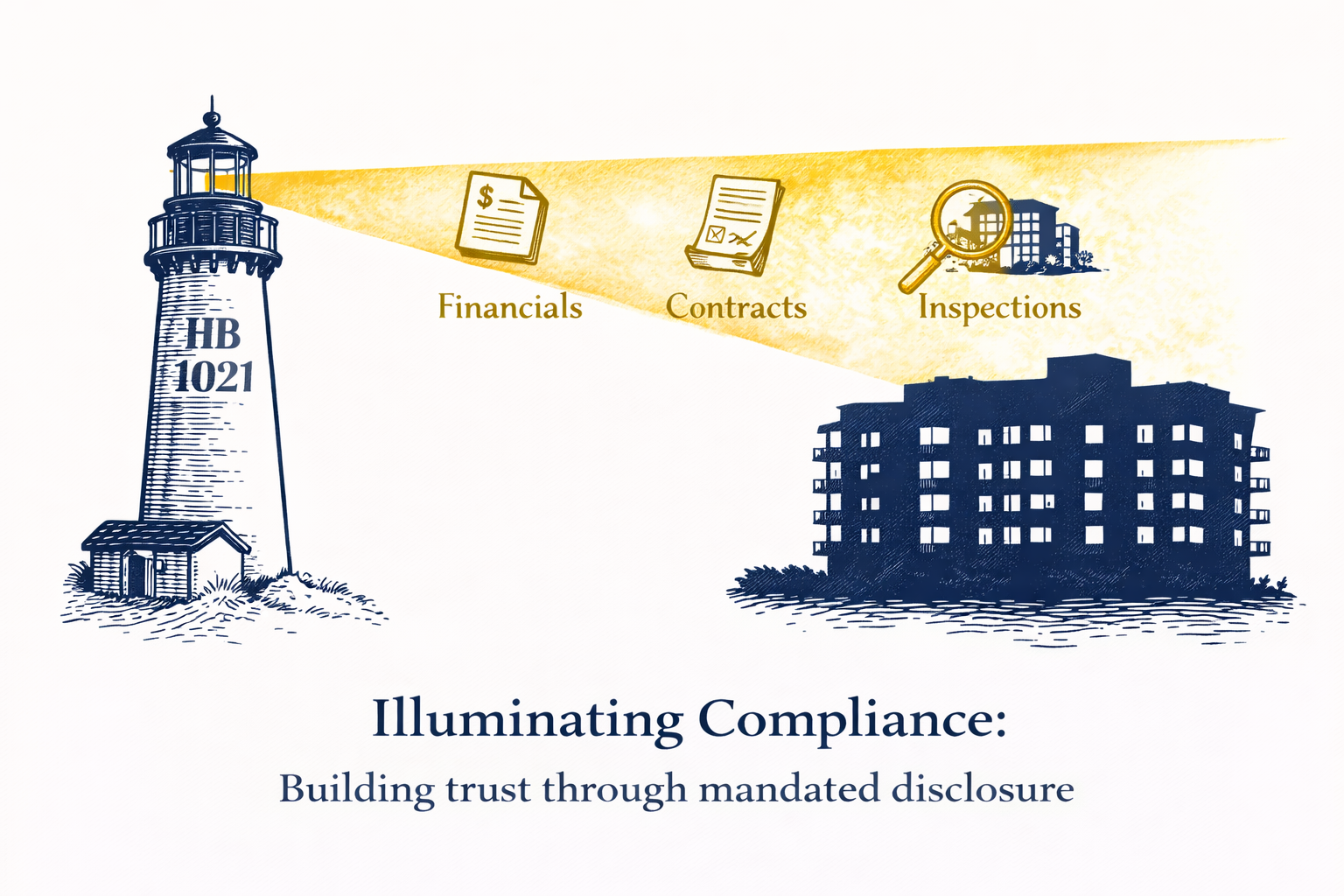
This methodology moves beyond the bare minimum of the law. By creating a Digital Hub that exceeds HB 1021’s requirements—publishing not just the mandated contracts and budgets, but also “Contextual Content” (FAQs, Milestone Inspection explainers)—boards can de-escalate tension. As our work with Pardo Jackson Gainsburg & Shelowitz, PL demonstrates, the goal of Public Relations in this context is to frame the board as the “Trusted Guide” navigating state regulations rather than an “Opaque Entity” imposing them.
Comparison: Pre-HB 1021 vs. Post-HB 1021
Here is the breakdown of the new landscape for Florida boards.
| Feature | Old Florida (Pre-HB 1021) | New Florida (Post-HB 1021) |
| Record Keeping | Physical binders / On-site | Mandatory Digital Portal (25+ units) |
| Board Ethics | Basic disclosure | Strict conflict-of-interest filings |
| Educational Mandate | Optional for most | Mandatory for all board members |
| Penalties | Civil / Administrative | Potential Criminal (for record hiding) |
| Outcome | Informal Oversight | Rigid Accountability |
3 Steps To Align With the New Law
Based on the controversy and new rules, here is the INGAGE blueprint for compliance.
1. Build the “Compliant Portal”
Don’t wait for a resident request to modernize.
Action: Associations with 25 or more units must have a searchable website for records. This is no longer a luxury; it is a legal defense. Every contract, financial report, and meeting notice should be one click away for every owner.
2. Standardize Ethical Disclosures
Transparency prevents litigation.
Action: Implement a rigorous protocol for board members to disclose any conflicts of interest regarding vendors or contracts. Publicizing these disclosures on the portal removes the “appearance of impropriety” that often triggers lawsuits.
3. Educate to De-escalate
Tell the “Why” behind the “What.”
Action: Use your digital channels to explain HB 1021 to residents. If special assessments are rising due to mandatory structural reserves, frame the communication around state-wide compliance. This shifts the “villain” role from the local board to the state mandate.
Frequently Asked Questions (FAQ)
What is the most controversial part of HB 1021?
The introduction of criminal penalties for specific acts, such as the intentional destruction or concealment of records, has sparked significant debate. It places a much higher burden of responsibility on volunteer board members.
Does this law apply to my association?
While many provisions apply to all condo associations, the requirement for a searchable digital records portal is specifically for associations with 25 or more units.
How does this affect assessments?
The law goes hand-in-hand with earlier reforms requiring full funding of structural reserves. While HB 1021 focuses on how boards operate, the result is often higher assessments that must now be communicated with absolute transparency.
Why is an integrated PR/Legal approach necessary?
Because these laws are being “quietly” signed, but loudly litigated. Firms like Pardo Jackson Gainsburg & Shelowitz, PL use media hits and strategic communication to ensure their clients aren’t caught off guard by the public and legal shifts.
Is your board operating in the light or the shadows?
Contact the INGAGE team today to ensure your association or law firm is leading the conversation on transparency and compliance.