
Quick Summary: For California law firms, the line between an effective marketing campaign and an ethical violation is razor-thin. While Rule 7.1 demands absolute transparency, the competitive nature of legal marketing often pushes firms toward superlative language. Staying compliant requires a “Lockstep” approach—merging aggressive growth strategies with a deep understanding of the State Bar’s definitions of “misleading” and “omitted” facts.
The Inherent Friction: “Compelling Growth” vs. “Ethical Constraint”
In the hyper-competitive California legal market, firms are under immense pressure to stand out. The marketing instinct is to lead with bold claims, impressive success rates, and superlative titles to capture the attention of potential clients in their moment of need.
However, the California State Bar operates on a principle of extreme caution. Where a marketer sees an opportunity to call a firm “The Best,” a regulator sees a “misleading statement” that creates an unjustified expectation. This creates a constant “Civil War” within firms: the marketing department wants to win the click, while the ethics counsel wants to avoid a disciplinary inquiry.
Why This Disconnect Is Dangerous
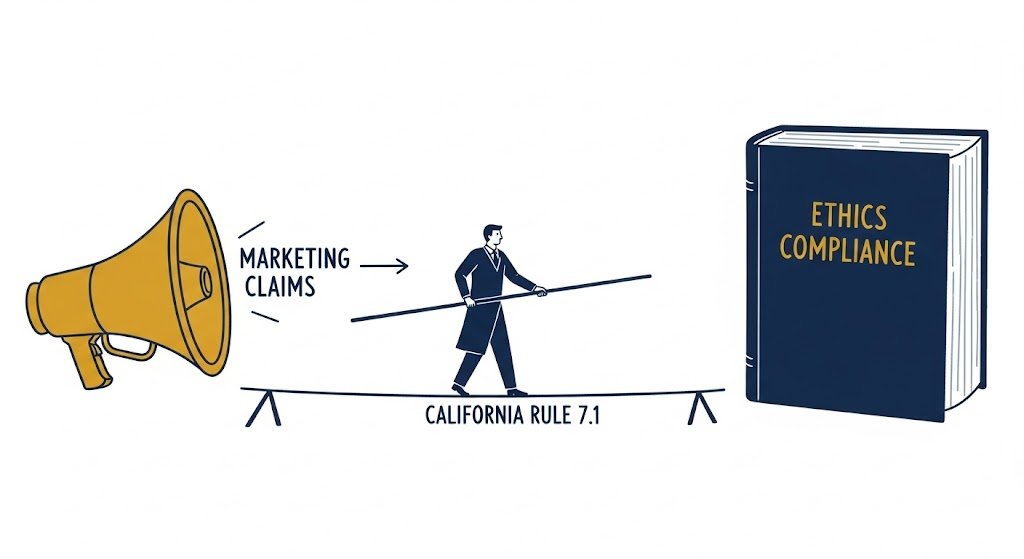
Navigating California’s Rule 7.1 without a unified strategy puts the firm at significant risk. It isn’t just about what you say; it is about what the consumer perceives.
The Trap of Truthful Statements: A statement can be 100% factually true but still be considered “misleading” if it omits a fact necessary to make the communication, as a whole, fair.
Unjustified Expectations: Highlighting a multi-million dollar win without proper context can lead a reasonable person to form an unjustified expectation that the same result is guaranteed for them.
The “Omission” Penalty: Failing to include the name of at least one responsible attorney or the word “Advertisement” can result in immediate compliance strikes, even if the content of the ad is perfect.
The INGAGE “Compliance-First” Methodology
At INGAGE, we believe that compliance shouldn’t be a barrier to creativity—it should be the framework for it. By understanding the nuances of the California Bar rules, firms can craft narratives that are both powerful and protected.
The goal is to shift from “Superlative Marketing” (claiming to be the best) to “Substantive Marketing” (proving value through transparency). This methodology relies on providing all “pertinent information” so that the public can make an informed decision without being led toward a foundationless conclusion.
Comparison: The Language of Compliance
Understanding the shift from high-risk language to compliant authority is essential for any California firm.
| High-Risk (Prohibited) | Compliant (Strategic) | The “Why” |
| “The Best Trial Lawyers” | “Experienced Trial Advocacy” | Avoids unverifiable superlatives. |
| “Lowest Fees Guaranteed” | “Transparent Flat-Fee Pricing” | Removes guarantees you cannot objectively prove. |
| “We Will Win Your Case” | “Dedicated to Seeking Results” | Prevents “unjustified expectations” of success. |
| Anonymous Firm Ads | “Lead Attorney: [Name/Address]” | Satisfies the requirement to identify a responsible party. |
| “Most Successful” | “Results-Driven Representation” | Focuses on the process rather than a subjective rank. |
3 Steps to Ensure Law Firm Ad Compliance
To successfully market your firm in California, follow these three steps to align your creative output with ethical obligations.
1. Audit for “Superlative” Omissions
Review every piece of copy for words like “best,” “highest,” or “will.” California regulators look for statements that imply a guarantee.
Action: Replace absolute statements with descriptive ones. Instead of saying you have the “best results,” describe the specific types of complex cases you have successfully navigated.
2. Standardize the “Advertisement” Protocol
The law is clear: solicitation must be identifiable. This applies to email campaigns, social media ads, and traditional print.
Action: Ensure the word “Advertisement” or “Solicitation” is clearly visible. Additionally, verify that every ad identifies at least one specific attorney by their full name and office address to meet California’s identification requirements.
3. Contextualize Success (The Disclaimer Strategy)
Client testimonials are a powerful marketing tool, but they are also a compliance lightning rod.
Action: Never post a result or a testimonial in a vacuum. Always include a clear disclaimer stating that “prior results do not guarantee a similar outcome.” This prevents the “reasonable person” from forming an unjustified expectation of their own case.

Frequently Asked Questions (FAQ)
What are the California Bar rules for attorney testimonials?
Under Rule 7.1, testimonials are allowed but must not lead a reasonable person to form an “unjustified expectation” of similar results. This usually requires a clear disclaimer and ensuring the testimonial does not omit facts that would make the success story misleading.
Is an email campaign considered an “advertisement” in California?
Yes. The California State Bar defines advertising as any public solicitation or private communication, including email. These communications must be labeled as advertisements and must identify at least one attorney responsible for the content.
Why can’t California lawyers use words like “Best” or “Lowest” in ads?
These are considered “absolute statements” that imply a guarantee or a qualitative rank that cannot be objectively proven. Using them is seen as deceptive because they may lead a potential client to formulate a conclusion without a reasonable factual foundation.
Does every law firm ad in California need an attorney’s name?
Yes. Rule 7.2 requires that any communication made on behalf of a firm must include the name and office address of at least one lawyer or law firm responsible for its content.
Is your firm’s marketing protected or at risk?
Contact the INGAGE team today. we work with dozens of lawyers and law firms to help them build dominant brands that remain fully compliant with the intricacies of California State Bar laws.