

Quick Summary: The “magic number” of blog posts is often the most debated topic in digital marketing, but quantity without a strategy is just noise. As INGAGE CEO Katherine Doble highlights, high-ranking SEO isn’t just about the frequency of your uploads; it’s about aligning your publishing schedule with Google’s E-A-T (Expertise, Authoritativeness, and Trustworthiness) standards. A “Lockstep” approach prioritizes consistent, high-value content that establishes your firm as a dominant authority rather than just another voice in the crowd.
The Inherent Friction: “Volume” vs. “Value”
In the quest for search engine dominance, organizations often face a tug-of-war between their content production speed and the quality of their insights.
On one side, the Volume Approach suggests that more is better. The logic is that more posts equal more keywords and more “hooks” in the water to catch search traffic. On the other side, the Value Approach focuses on deep-dive, high-authority pieces that provide real solutions to complex problems. The friction arises when a firm tries to scale volume at the expense of quality, leading to thin content that search engines ignore and users find unhelpful.
Why This Disconnect Is Dangerous
Failing to strike the right balance between frequency and quality can actively hurt your rankings.
The “Thin Content” Penalty: If you publish 20 short, poorly researched posts a month, Google may flag your site as “low value,” potentially dragging down the ranking of your better pages.
Erosion of Trust (E-A-T): Expertise and Trustworthiness are core ranking factors. If a potential client finds a blog post that feels automated or generic, you’ve lost the “Trustworthiness” battle before it even begins.
Wasted Resources: Producing content that doesn’t rank or convert is a drain on your marketing budget that provides zero long-term ROI.
The INGAGE “Strategic Frequency” Methodology
Katherine Doble recommends a data-driven approach to frequency. While INGAGE SEO experts suggest a minimum of ten blog posts per month for firms in highly competitive markets, the goal is never just to hit a number.
Our methodology relies on “Rapid Learning” of industry trends and “Strong Writing” that showcases your team’s expertise. By focusing on Google’s E-A-T framework, we translate your technical knowledge into authoritative content that search engines love to reward with high-page visibility.

Comparison: The Ideal Frequency Strategy
| Market Competitiveness | Recommended Monthly Posts | Focus Area |
| High Competition | 10+ Posts | Targeting long-tail keywords & high-volume terms |
| Moderate Competition | 4-8 Posts | Deep-dive thought leadership & FAQ articles |
| Niche/Low Competition | 2-4 Posts | Establishing foundational trust and local SEO |
| The “INGAGE” Standard | Consistent & High-Quality | Balancing E-A-T with consistent publishing |
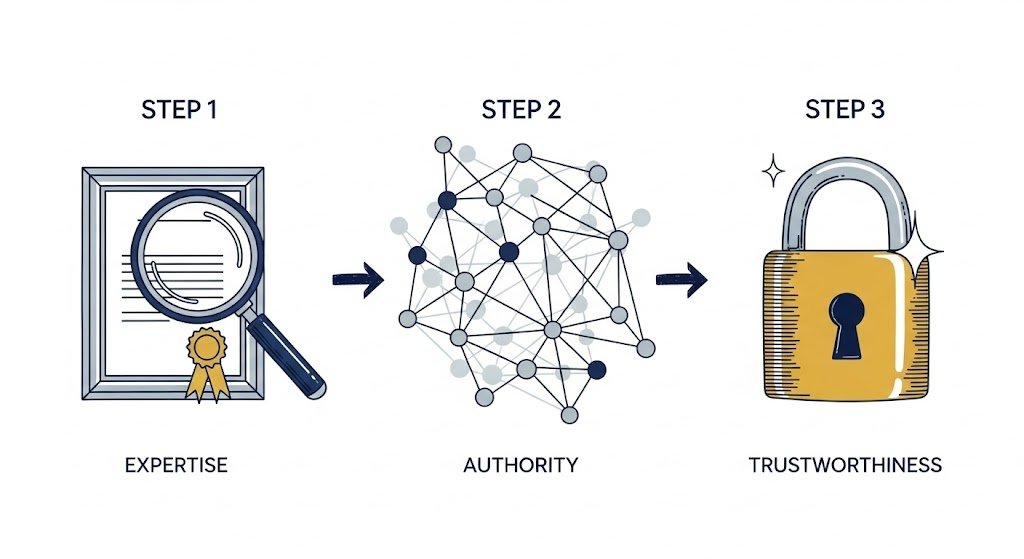
3 Steps to Optimize Your Content for E-A-T
To rank high, your content must satisfy both the search engine’s algorithm and the user’s need for expertise.
1. Showcase Your Expertise
Google values content created by subject matter experts.
Action: Don’t just write about a topic; prove you know it. Use data, case studies, and specific author bios that highlight your credentials and years of experience.
2. Build Authoritative Backlinks
Authority is a social proof for search engines.
Action: Seek guest posting opportunities on reputable industry sites and collaborate with other experts. When other high-authority sites link to your content, it tells Google your firm is a leader in its field.
3. Fortify Trustworthiness
Trust is the final pillar of E-A-T.
Action: Ensure your site features clear privacy policies, secure SSL certificates, and—most importantly—authentic client testimonials. A site that looks and feels secure is more likely to be rewarded with a top spot.
Frequently Asked Questions (FAQ)
Is it better to post one long article or several short ones?
In the eyes of SEO, one comprehensive, high-quality article (1,500+ words) that thoroughly answers a user’s query usually outperforms several short, “thin” posts. Long-form content provides more opportunities for E-A-T signals and keyword integration.
How long does it take for a new blog post to rank on Google?
Generally, it can take anywhere from 3 to 6 months for a post to reach its peak ranking potential. This is why consistency is key; a “Lockstep” strategy involves building a library of content that gains momentum over time.
Does the “Author” of the blog post really matter for SEO?
Yes, significantly. Under Google’s E-A-T guidelines, the reputation and credentials of the person writing the content are assessed. Using a real person’s name with a detailed bio and links to their professional credentials helps establish the “Expertise” required for high rankings.
What is “Thin Content” and why is it a risk?
Thin content refers to pages that provide little to no value to the user—such as very short posts, repetitive text, or content clearly generated by AI without human oversight. Google may penalize sites that have a high ratio of thin content, as it degrades the user experience.
Is your content strategy designed for high-ranking success?
Contact the INGAGE team today for a comprehensive SEO audit. We’ll help you build a content calendar that balances frequency with the authority needed to dominate the search results.