
Quick Summary:
The launch of Apple’s iOS 14 introduced a seismic shift in digital marketing: the App Tracking Transparency (ATT) framework. By allowing users to opt out of tracking, Apple severed the direct line between ad spend and clear attribution. As INGAGE outlines, this isn’t just a technical update—it is a fundamental change in how businesses must approach data, forcing a pivot from “passive tracking” to “active verification.”
The Inherent Friction: “User Privacy” Vs. “Ad Personalization”
For years, digital advertising relied on a silent agreement: platforms tracked user behavior to serve hyper-relevant ads, and businesses paid for that precision. Apple’s iOS 14 update shattered this ecosystem, creating a standoff between two massive forces.
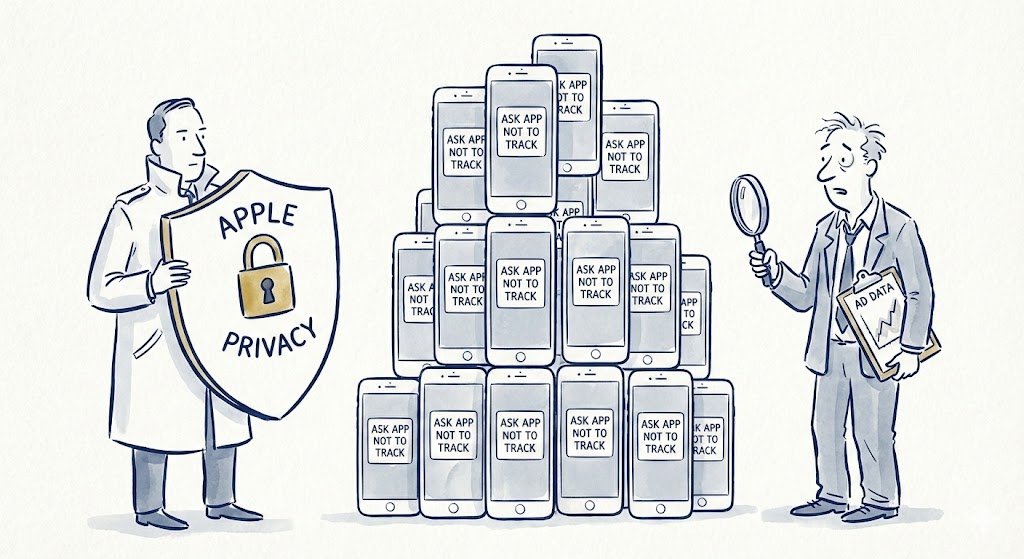
On one side, Apple is championing user privacy, giving consumers the power to block data collection with a single tap. On the other side, Facebook (Meta) and Advertisers rely on that data to measure success. When a user taps “Ask App Not to Track,” the feedback loop breaks. The Facebook Pixel goes blind, retargeting pools shrink, and the “RoAS” (Return on Ad Spend) metrics that businesses live by become murky.
Why This Disconnect Is Dangerous
INGAGE warns that ignoring this shift is not an option. The “wait and see” approach leads to wasted budget and blind decision-making.
If you rely solely on old tracking: Your reporting will be inaccurate. You might turn off winning ads because they look like they aren’t converting, or scale losing ads that are merely claiming credit for organic traffic.
If you abandon the platform: You lose access to one of the most powerful discovery engines in the world. The audience hasn’t left Facebook/Instagram; only the measurement has changed.
INGAGE’s Methodology: “The Pivot to Ownership”
The solution is not to fight the platform, but to secure your own standing within it. INGAGE advises a strategy of “Technical Verification & Data Ownership.”
The philosophy is simple: You can no longer rent your data access from Facebook; you must own the infrastructure. This means moving from “lazy” pixel tracking to robust, server-side verification and prioritizing the data that matters most to your bottom line.
Comparison: The Tracking Paradigm Shift
To navigate the post-iOS 14 world, marketers must understand what has been lost and what must replace it.
| Feature | The Old Way (Pre-iOS 14) | The New Way (INGAGE Strategy) |
| Data Source | Third-Party Cookie / Pixel | First-Party Data / CAPI |
| Attribution | 28-Day Click Windows | 7-Day Click / 1-Day View |
| Optimization | Unlimited Conversion Events | 8 Prioritized Events (Aggregated) |
| Retargeting | Automatic Website Visitors | Customer Lists & Video Views |
| Focus | “Trust the Algorithm” | “Verify the Domain” |
3 Steps To Secure Your Ad Strategy
Based on INGAGE’s analysis, here are the immediate technical and strategic steps businesses must take to protect their campaigns.
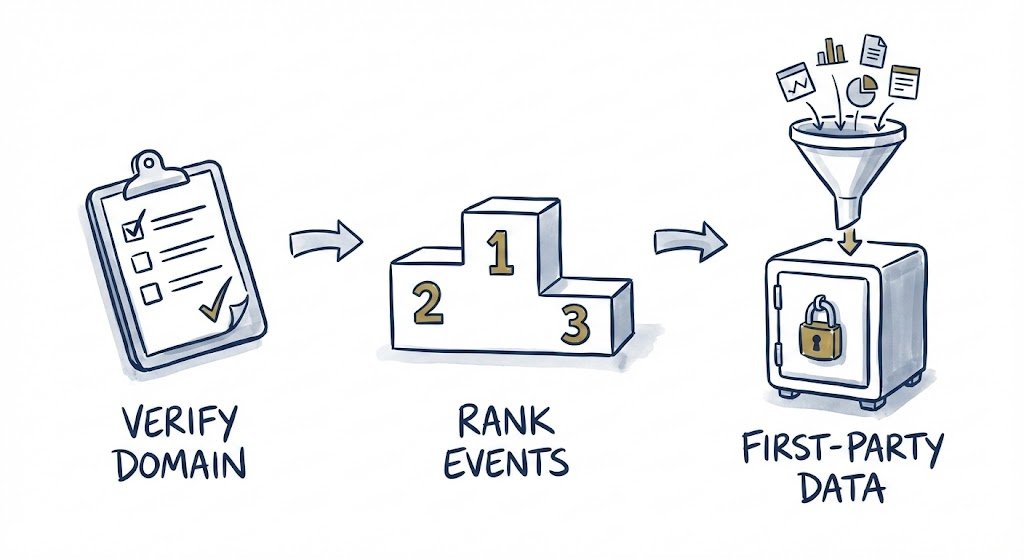
1. Verify Your Domain
You must prove to Facebook that you own your website. This is no longer optional.
Action: Go to Facebook Business Manager > Brand Safety > Domains. Add your URL and verify it via DNS record or HTML upload. This “handshake” allows you to prioritize which conversion events Facebook tracks, bypassing some of the Apple blocks.
2. The “Aggregated Event” Priority
With data limited, you cannot track everything. You must tell Facebook what matters most.
Action: Configure your Aggregated Event Measurement. Rank your top 8 events (e.g., #1 Purchase, #2 Add to Cart, #3 View Content). If a user opts out of tracking, Facebook will only report the highest priority event they completed. If you don’t rank them, you lose the data entirely.
3. Diversify Your Data Stream
Reliance on a single pixel is risky.
Action: Stop relying 100% on the browser pixel. Implement the Conversions API (CAPI) to send data directly from your server to Facebook, and focus on building your own email/SMS lists (First-Party Data) that you can upload for targeting, independent of Apple’s tracking rules.
Frequently Asked Questions (FAQ)
Does iOS 14 mean Facebook Ads don’t work anymore?
No. It means the tracking is less granular. The ads still reach people, and people still buy. The difference is that the reporting dashboard may show fewer conversions than are actually happening. You need to look at holistic business metrics (overall revenue vs. ad spend) rather than just the Ads Manager dashboard.
What happens if I don’t verify my domain?
If you don’t verify your domain, you cannot configure your Aggregated Event Measurement. This means you cannot optimize for specific actions like “Purchase” or “Lead” effectively, and your ads will likely suffer from poor delivery and higher costs.
Why are my retargeting audiences shrinking?
Because users who tap “Ask App Not to Track” are removed from your automatic “Website Visitor” audiences. To fix this, focus on in-app retargeting (e.g., people who watched a video on your Facebook page) or upload your own customer lists, as these sources are not blocked by Apple’s update.
What is the “8 Event Limit”?
To comply with Apple’s data limits, Facebook allows only 8 conversion events per domain (e.g., Purchase, Add to Cart, Lead). You must rank them by importance. If a user completes multiple actions, only the highest-ranked one is reported.
Is your ad strategy future-proof?
Contact the INGAGE team today to audit your tracking setup and build a resilient data strategy that performs regardless of software updates.
Schedule an initial complimentary call with a member of our team